
The real problem was a missed-call loss
Media reports describe Mana as a seventh-grade student who began learning Python at nine. At her father's small business, she saw staff miss calls while they were busy. A missed call was not an abstract technology problem: it could mean a customer, an appointment, or a sale that never reached the team.
That observation shaped the product. Instead of starting with a general-purpose chatbot, she focused on an AI receptionist that could answer calls, schedule appointments, and record orders. The narrow problem gave her a real place to test the workflow and a concrete reason a small business might care.
Two weeks and hundreds of calls are not revenue
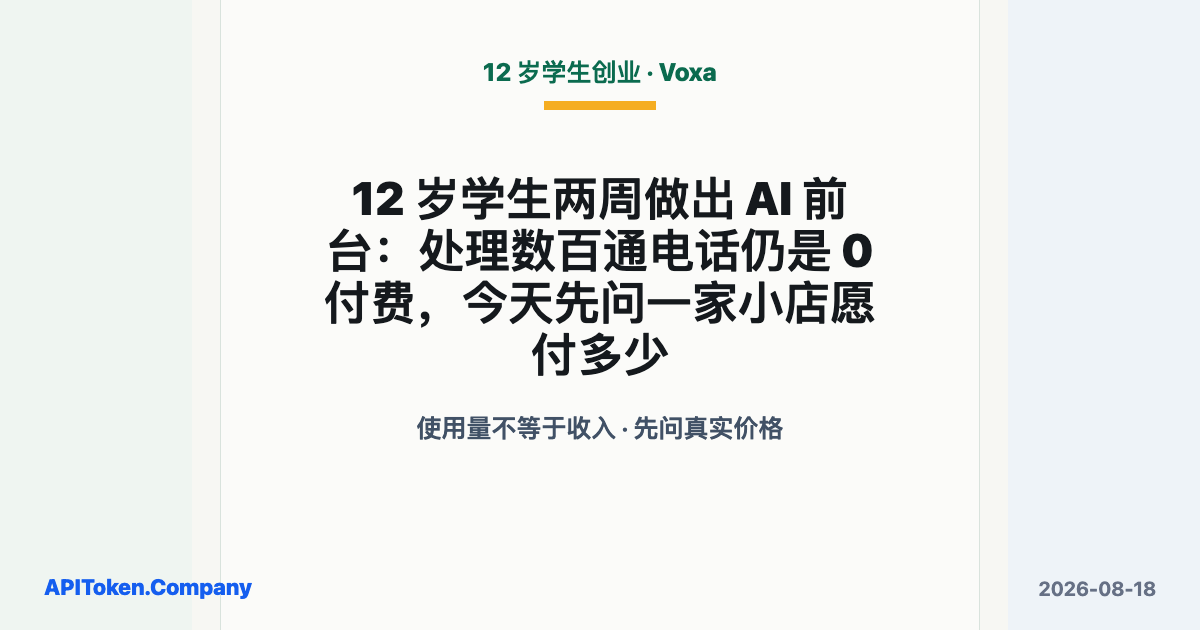
The reported timeline is short: a basic system was built in about two weeks and later handled hundreds of calls. The same public material says she was still looking for the first paying customer. The useful distinction is simple but easy to lose when a story is summarized as an impressive usage number: a call handled is an operational event, not a payment.
The metric is therefore calls handled and zero paid customers. It is not MRR, ARR, profit, or audited revenue. The public reports do not provide a full ledger for call costs, refunds, support, maintenance, or the time spent by the family business. A working prototype can still need a different offer, customer, or payment moment.
The revenue mechanism still needed a buyer
The intended business model was to charge small businesses for an AI voice receptionist that answers calls, books appointments, and records orders. AI-assisted coding reduced part of the implementation work: the project was built from a real scenario, with ChatGPT or Claude helping generate code in small pieces that could be tested step by step.
None of that removes the sales test. A business owner must decide that missed-call loss is urgent, trust the system with a real workflow, and accept a price that covers model usage, maintenance, and human recovery. Until that happens, hundreds of calls demonstrate usage, not a validated business.
The conditions behind the story matter
Mana had several advantages that should remain visible: she started learning Python at nine, her family's business supplied a real testing environment, and media attention plus youth entrepreneurship support created additional visibility. These factors do not make the project meaningless. They explain why the first prototype could be built and tested quickly.
An ordinary builder should copy the validation order rather than the biography. Start with a measurable loss, keep the first user group narrow, and separate usage evidence from payment evidence. Different skills, audiences, and cash flow mean the fair goal is one small paid proof, not a promise to reproduce somebody else's attention.
Ask one shop for a real price today
Find one small shop that can name a concrete loss caused by missed calls. Ask what a monthly receptionist result would be worth, what calls it would be allowed to handle, and what a human must review. Write down one user type, one input, one output, and one acceptance rule before adding more features.
If nobody will name a price or provide a real test, revise the problem or the offer instead of treating more calls as proof. If someone agrees to pay, record call volume, failed requests, model usage, correction time, and support effort beside the payment. The first small invoice is more informative than a large usage counter.
Use APIToken as a bounded experiment entry point
The case has no evidence of using APIToken. For a similar workflow, a user can work within the models currently and lawfully offered at https://APIToken.Company, create an isolated project key, check the public status page, and run one minimal real call with a small budget. Record the effective model, response status, visible usage, retries, and human correction time.
That process supports low-cost testing, observable status, safer project separation, and model choice by task. It does not bypass provider rules or guarantee revenue. Model availability, prices, groups, and channel health follow the current public pages and the result of the real request.
Source and evidence boundary
The source material is an Exame report, '12-year-old creates AI receptionist for small businesses,' and a Business Insider Japan report about a young founder building an AI receptionist. They are treated as grade B media evidence about the project, its age, its timeline, and its usage status.
Hundreds of calls are usage, not income. The reports say the project was still seeking its first paying customer, so the result remains zero paid customers rather than a financial success claim. No public evidence shows that Mana Jampala, Voxa, or the family business used APIToken.