
Employment pressure is changing the proof employers want
China's National Bureau of Statistics reported an average urban surveyed unemployment rate of 5.2 percent for January through July 2026, describing employment as generally stable. Policy commentary also notes that AI can displace some tasks while creating new occupations and roles. The implication is not that every traditional job disappears; it is that candidates need clearer evidence of how they create results.
FDE is an emerging hybrid role in that transition. It combines engineering, customer discovery, model behavior, evaluation, security, and adoption. A high compensation range reflects that bundle of responsibility and market conditions, not a guaranteed income for a reader.
What the FDE role does with AI
OpenHands FDEs install an AI coding platform in customer-managed infrastructure and handle identity, OAuth, connectors, and adoption. Give an AI model a redacted repository task. Ask for a change plan, files, tests, and rollback steps; treat connector or permission failures as delivery evidence.
The source posting describes responsibilities and compensation, not a documented APIToken relationship or a particular customer case. The exercise here is a transparent translation of the role into a testable AI delivery task: define the input, expected output, failure cases, human handoff, and rollback before calling the work production-ready.
Why the workflow needs a Token
MCP and OAuth work must be traceable. An isolated Token shows which project made each request, how much it used, and where human takeover happened.
A Token is not a marketing word for access. It gives the request a project boundary and makes model, endpoint, usage, retry, budget, and failure evidence attributable. Without that record, an impressive response remains an unrepeatable demo and a team cannot explain its cost or ownership.
Run the smallest useful experiment
Run one small redacted coding task through APIToken, then record the model, Token usage, connector errors, approval points, and rollback result.
Use the same input across a small set of currently available models. Record usable-output rate, latency, Token usage, manual correction time, failures, and the condition that stops the experiment. A model being visible in a marketplace does not prove that this task will complete under the intended budget and data boundary.
Turn the result into a work sample
Keep the redacted input, model and version, request log, budget ceiling, acceptance threshold, failure examples, human takeover point, and rollback path. This evidence is more useful in an FDE interview than a screenshot without context.
APIToken can be used as a bounded practice surface for this sequence: inspect current model and channel pages, create an isolated project key, run one real request, and review usage. It does not bypass vendor rules, replace an employer, or guarantee a job or income.
Source and evidence boundary
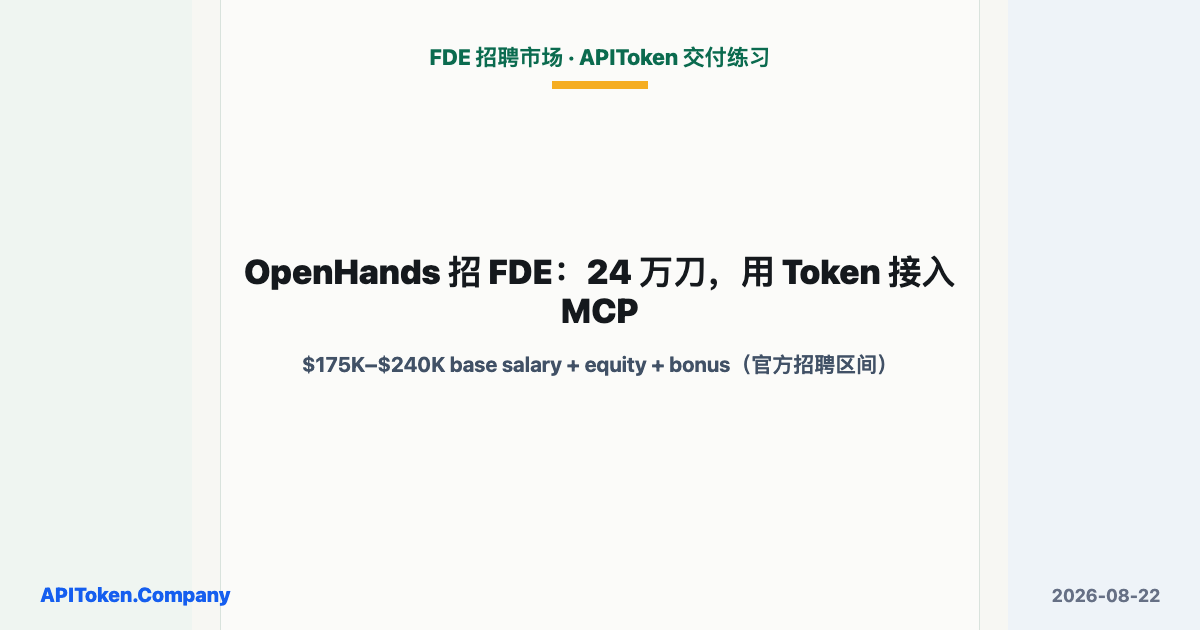
The public source is OpenHands Careers, “Forward Deployed Engineer (Post Sales).” Its published compensation language is $175K-$240K base salary plus equity and bonus, which is a role-level range and may include equity or bonus; it is not revenue, profit, take-home pay, or an offer to every applicant.
There is no evidence that this role used APIToken. Employment statistics and policy context are linked from China's National Bureau of Statistics and National Development and Reform Commission. Current models, prices, groups, and availability follow the live APIToken pages and the real request result.