
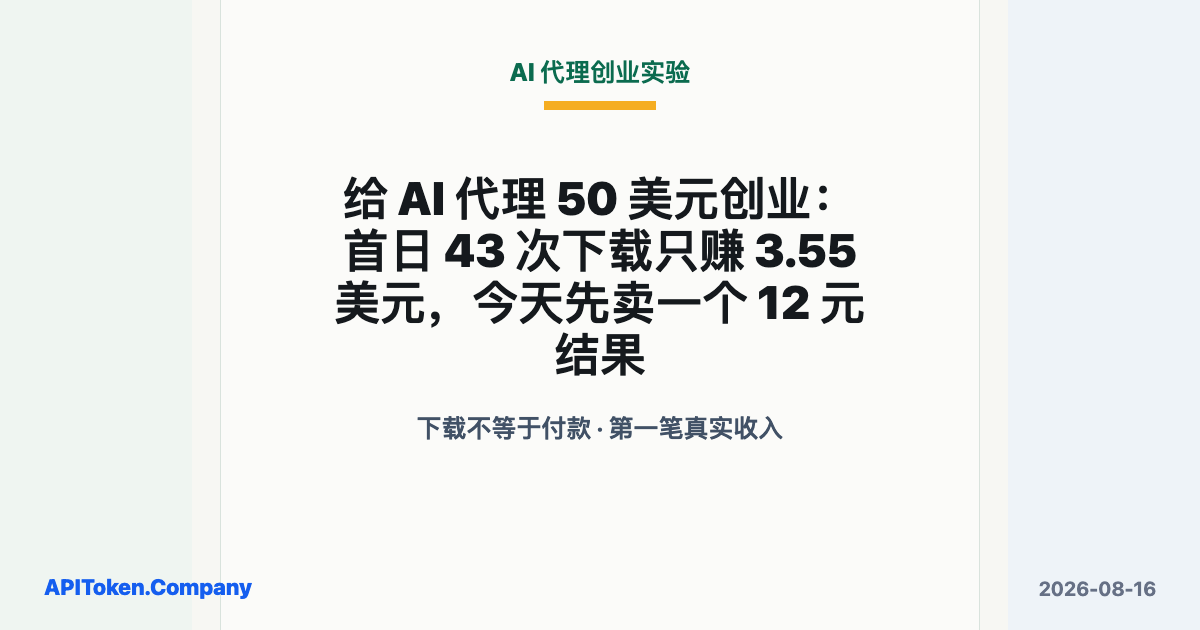
Forty-three downloads did not mean forty-three customers
Bowden set a deliberately concrete experiment: give an AI agent a $50 budget and ask it to earn enough for a $750 computer. The agent helped assemble a prompt product, cover art, landing page, and launch content. On the first day, the product received 43 downloads, but only one person made a voluntary payment of $3.55.
That small result is more useful than an automatic-income story because it separates attention from payment. A click, download, signup, or compliment is not proof that a business has begun. For someone without a first stranger payment, tracking those steps separately is a more honest signal than treating activity as revenue.
The payment came from a product and pricing design, not an AI label
The self-report describes an AI agent helping with a digital prompt product, its page, and launch materials, while Gumroad accepted voluntary payment. AI shortened part of the production and publishing work. The payment still depended on a visible problem, an acceptable result, and a price arrangement a person chose to accept.
The $50 budget is therefore not evidence that spending more creates revenue. It made the experiment bounded: publish one free-but-payable result, separate downloads from payments, and only then decide whether the product, model usage, or distribution deserves more time and money.
$3.55 was first sales revenue, not profit
The reported $3.55 is one first-day sales payment. The public post does not provide a full ledger for refunds, platform fees, taxes, model usage, production time, support, or ongoing maintenance. It cannot fairly be rewritten as net earnings, stable MRR, annual revenue, or a dependable income outcome.
The evidence grade is C because the source is the creator's public Indie Hackers account rather than an independent financial audit. Revenue, MRR, ARR, cost, and profit are different measures. Keeping the label beside the number preserves the value of a small paid proof without turning it into a fictional monthly-income claim.
The distribution advantages should stay visible
The case includes an existing public experiment and community-distribution ability. The post says a related Reddit post received roughly 200,000 views, and the digital product accepted voluntary overpayment. Those conditions affect discovery, trust, and payment behavior; they cannot be reduced to a universal rule that any AI agent with $50 will make money.
The transferable target is smaller: validate one real payment for your own result rather than copying another person's visibility or revenue. If no stranger pays, revise the problem, offer, or result before adding features, subscriptions, or model cost.
Sell one result under RMB 12 today
Choose one user type, one input, one output, and one result that could be sold for the equivalent of RMB 12 or less. Publish it, then record views, downloads, and payments separately. Set a cash and time limit in advance. A first payment is a reason to learn more; no payment is a reason to revisit the offer before expanding scope.
Within the models currently and lawfully offered at https://APIToken.Company, check the public status page, use a separate project key, set a small budget, and run one minimum real call. Record usage, failures, retries, and correction time. A visible model is not proof that the intended workflow will complete, and one successful request is not production readiness.
Source and evidence boundary
The source is Benny Bowden's Indie Hackers post, 'I gave my AI agent $50 and told it to buy its own computer.' It is a creator self-report about the experiment, the product work, downloads, and the first voluntary payment, rather than an independently audited financial statement.
The $3.55 figure remains self-reported first sales revenue, not profit or a promise of later results. Public material does not show that Bowden, Earendel, or the related product used APIToken. APIToken is mentioned only as a controlled way to isolate a project key, inspect status and usage, and bound a small test.